
Case study: Pro Patria stamp ‒ Celebrating Swiss cultural heritage
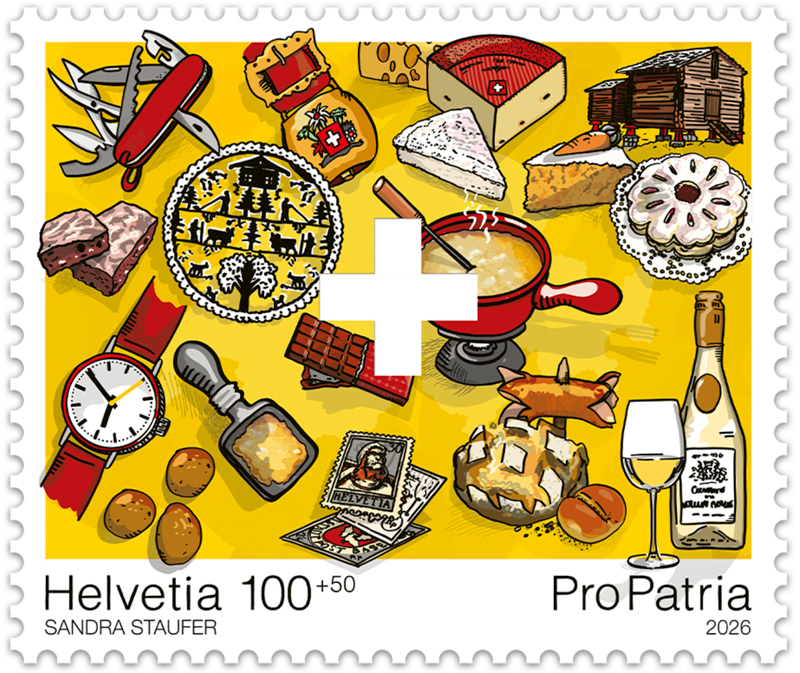
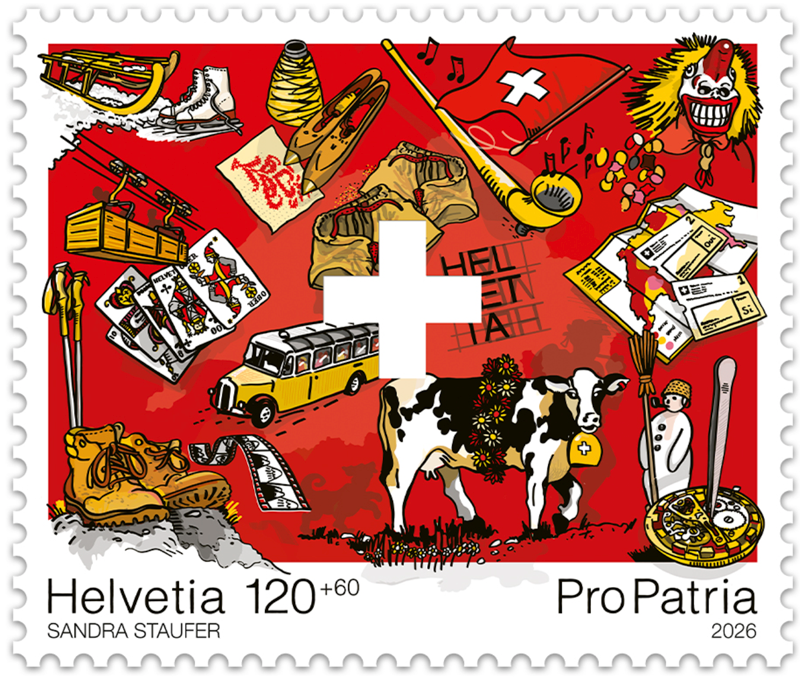
© Post CH Network Ltd
Pro Patria / Swiss Post 2026 (post.ch)
Stamps to celebrate the cultural assets and heritage of Switzerland
"Seit 1938 gibt die Schweizerische Post Sonder-Briefmarken Pro Patria mit einem Taxzuschlag heraus, welcher der Stiftung Pro Patria zugutekommt.
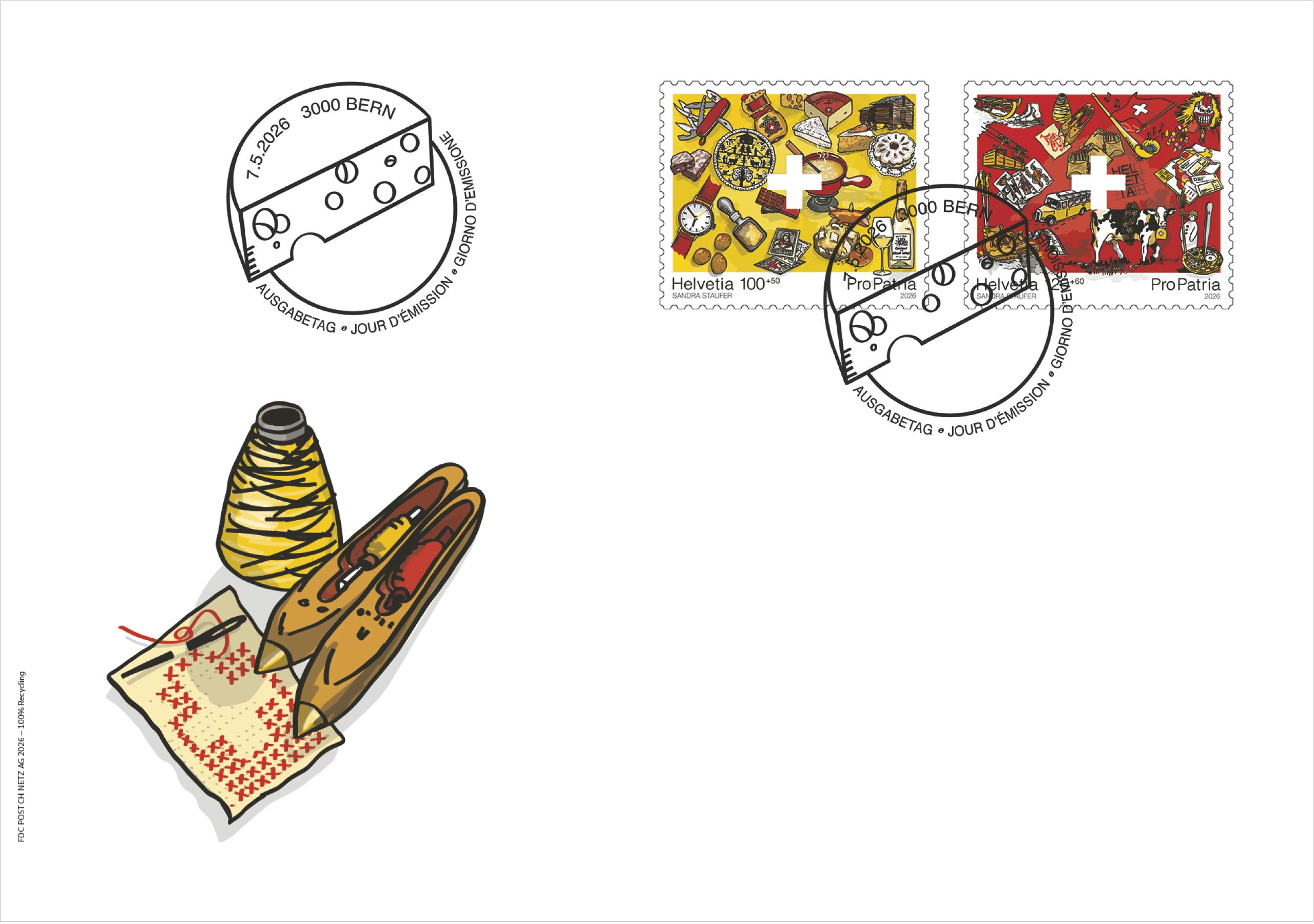
Die neuen Pro Patria-Briefmarken widmen sich dem kulturellen Reichtum der Schweiz in seiner ganzen Bandbreite. Im Fokus stehen materielle Kulturgüter wie kunsthandwerkliche Objekte oder Bauwerke sowie immaterielle Kulturgüter wie Traditionen, Musik, Wissen oder gelebte Bräuche. Gestalterisch verbunden werden die Sujets durch ein ausgestanztes Schweizerkreuz im Zentrum jeder Marke – ein prägnantes Detail mit grosser Symbolkraft.
Entworfen wurde die Ausgabe von der Auslandschweizerin und Illustratorin Sandra Staufer, die ihre kulturellen Wurzeln aus der Distanz reflektiert."
https://propatria.ch/briefmarken (Deutsch)
"Since 1938, Swiss Post has issued special Pro Patria stamps with a surcharge, the proceeds of which benefit the Pro Patria Foundation.
The new Pro Patria stamps are dedicated to the cultural richness of Switzerland in all its diversity. They focus on tangible cultural assets such as handcrafted objects or architectural works, as well as intangible cultural heritage such as traditions, music, knowledge, and living customs. The designs are unified by a die-cut Swiss cross at the center of each stamp- a striking detail with strong symbolic power.
The issue was designed by Swiss expatriate illustrator Sandra Staufer, who reflects on her cultural roots from afar.
https://propatria.ch/briefmarken (English)
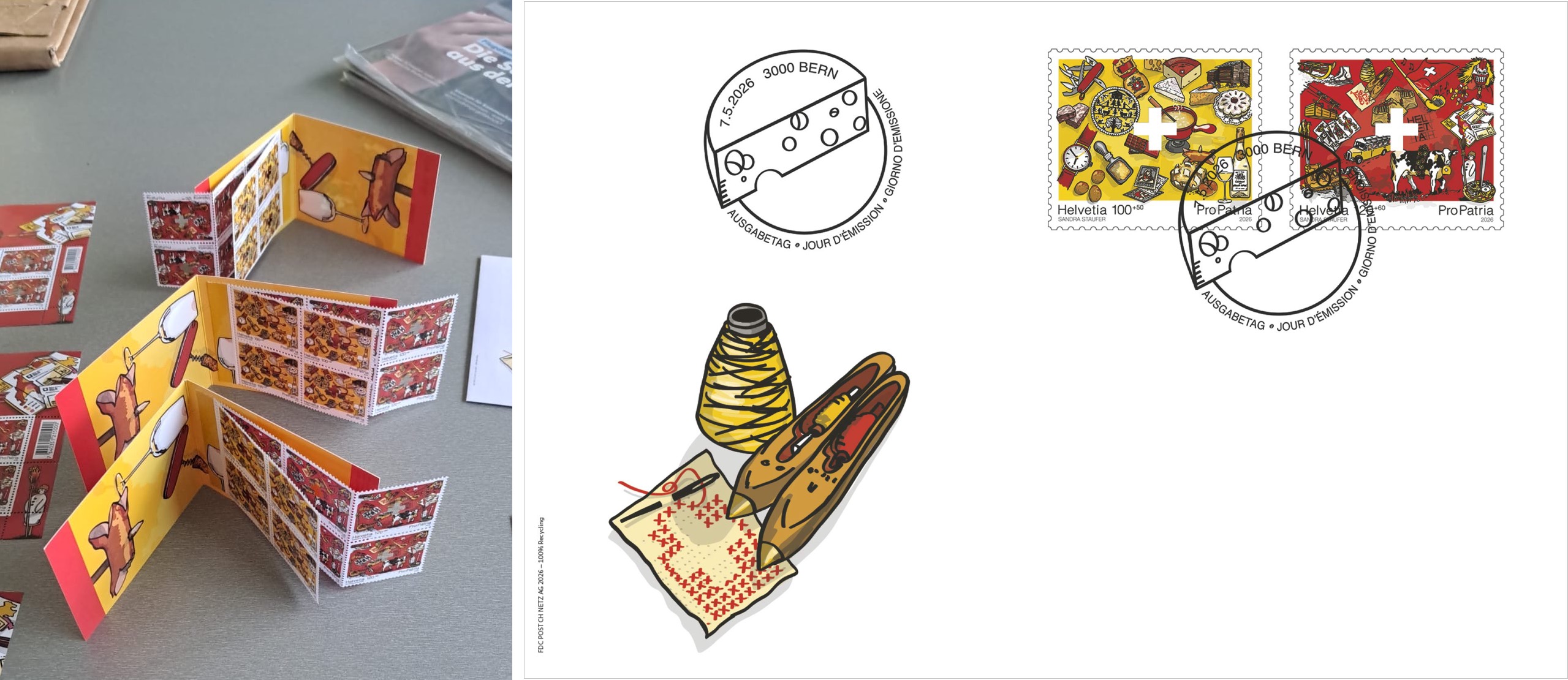
The Pro Patria stamps shine the spotlight on tangible and intangible cultural assets - from buildings to living traditions, putting cultural diversity on display.
Background
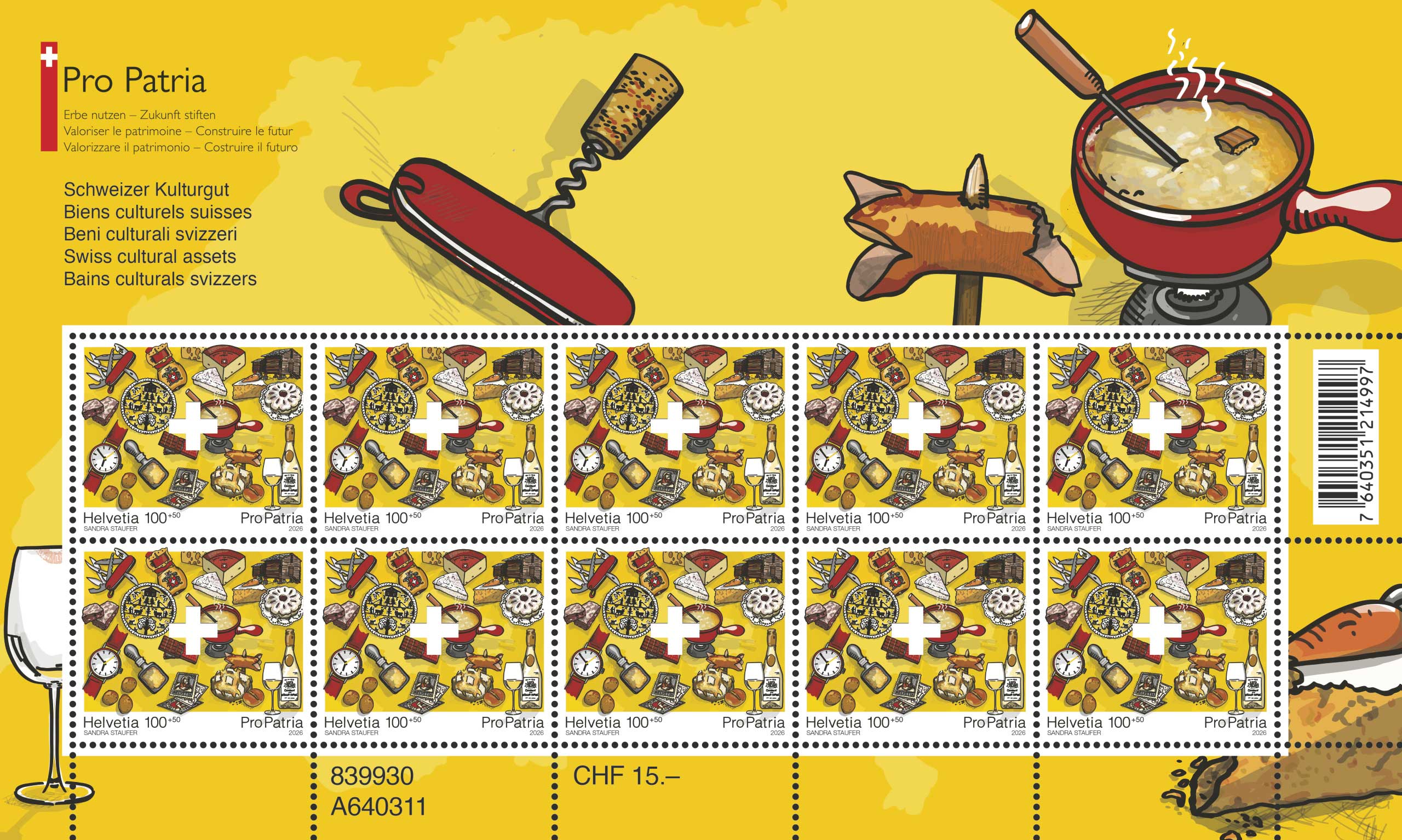
Swiss Post invited me to develop concepts on the theme of Switzerland’s cultural assets and heritage for a new Pro Patria stamp series. The series includes an A-Post (first-class) and a B-Post (second-class) stamp, which needed to relate to one another and read as a cohesive pair.
The design
When designing this stamp, I took a deliberately literal approach, assembling cultural elements into a cohesive pattern.
I aimed to create a textile-like pattern, reminiscent of traditional St. Gallen fabrics or Appenzell edelweiss textiles. On closer inspection, a wealth of detail emerges - elements drawn from the many regions and cultures of Switzerland, spanning both urban and rural life.
The finished product
My aim was to create an immediate sense of nostalgia - to evoke memories and a feeling of home.
This design is rooted in those deeply embedded fragments of memory that, for me, define Switzerland. The two bold colours - the distinctive Swiss red of our flag and the yellow of our much-loved Postbus - are inseparably linked to the warmth and sense of connection from my childhood.
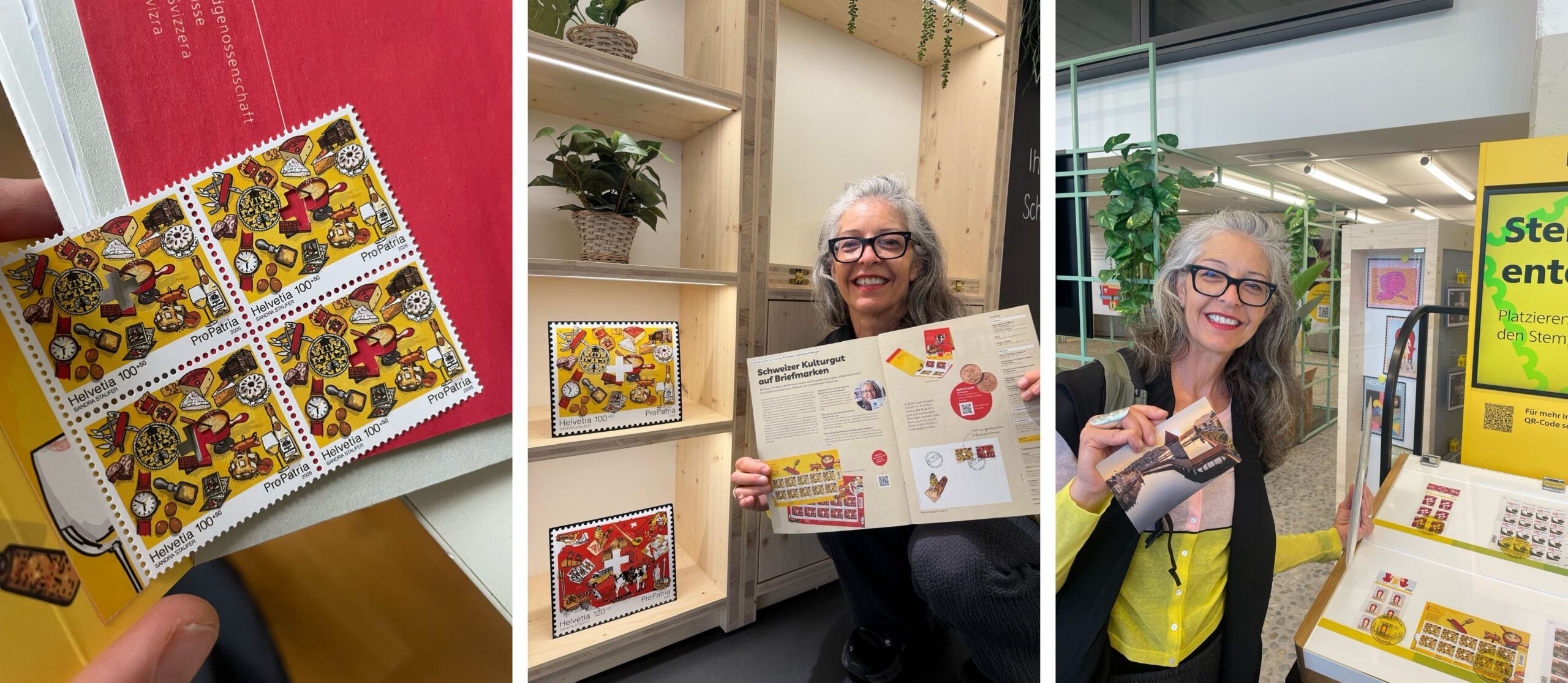
The cut-out cross serves as a metaphor for someone living away from their homeland.
A sense of home
Tangible and intangible cultural assets tell a story of belonging.
Cultural assets are of great importance because they play a central role in the identity, history, and cohesion of a society. For us Swiss living abroad, they are especially meaningful.
When designing this stamp, I took a very direct approach: I wove these elements into a pattern that, at first glance, conveys a feeling of home, familiarity, and nostalgia.
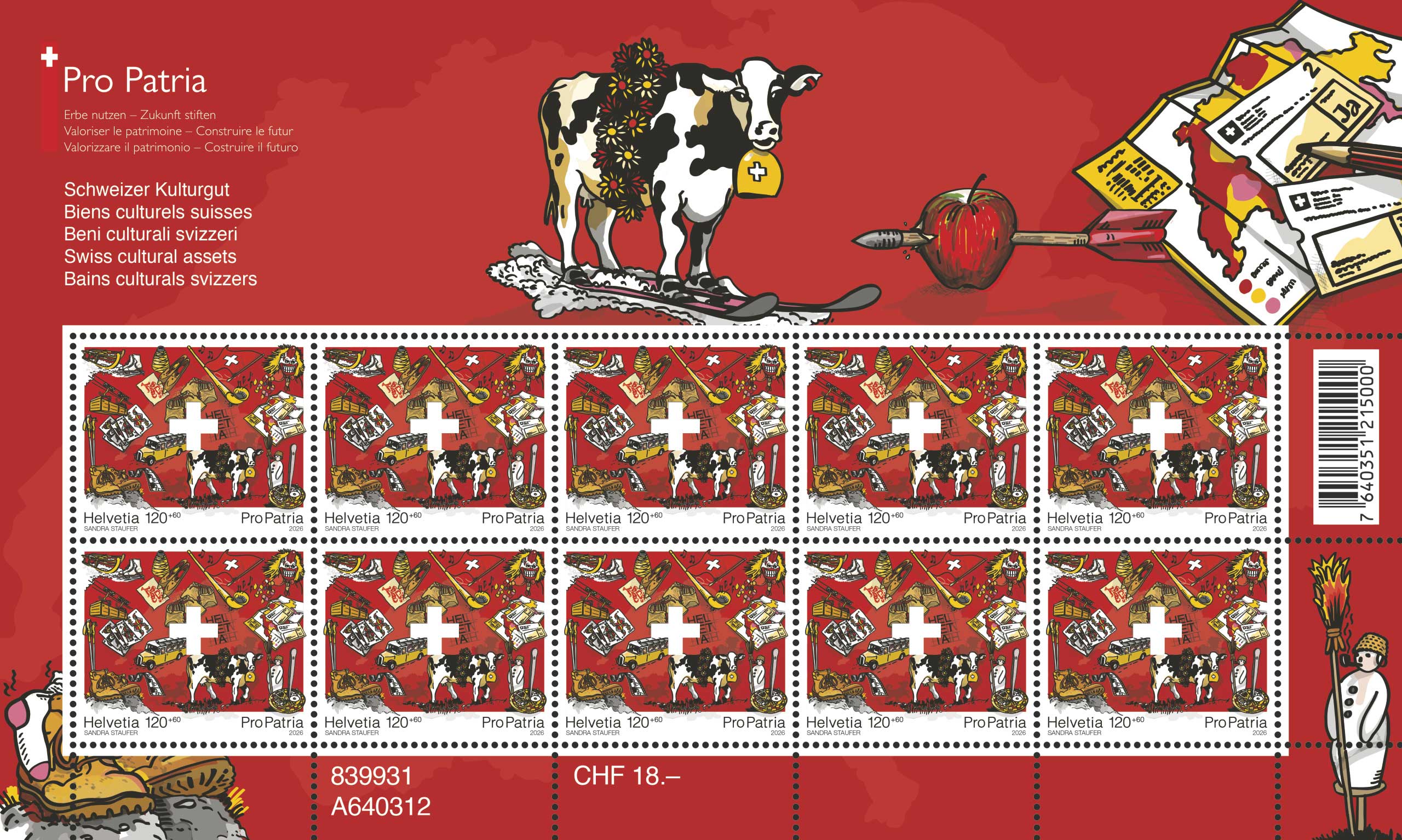
The cut-out cross serves as a metaphor for someone living away from their homeland.
Interview - iyf.ch - Deutsch
Im Auftrag der Schweizerischen Post für das Magazin Lupe.
Pro Patria ‒ Schweizer Kulturgut
Frage 1. Du lebst als Auslandschweizerin in Brighton. Inwiefern hat der räumliche Abstand deinen Blick auf die Schweiz und ihre Kulturgüter verändert?
Die Distanz, die das Leben in Brighton mit sich bringt, hat meine Verbundenheit mit der Schweiz nicht verringert, sondern meinen Blick geschärft, was die schweizerischen Kulturgüter betrifft. Distanz wirkt wie eine Linse. Wenn man innerhalb einer Kultur lebt, nimmt man ihre Werte oft als selbstverständlich an. Im Ausland wird einem bewusst, dass man von Teilnehmerin zur Botschafterin wird. So vertiefen sich auch der Stolz und die Verantwortung, diese Werte weiterzugeben.
Während das Schweizer Taschenmesser, die Leckerli und das Hergiswiler Glas tägliche Bestandteile unseres Lebens hier in Brighton sind, vermisse ich am meisten das Schweizer Design - jene zeitlose Präzision und Klarheit, verkörpert von Typografen wie Miedinger, Müller-Brockmann und Ruder. Ihre Werke sind für mich spezielle Kulturgüter; sie schmücken mein Studio und erinnern mich an die Verbindung zwischen Tradition und Innovation.
Unser Familienleben ist bewusst mit Schweizer Fäden durchzogen. Gemeinsame Ferien und der geleistete Militärdienst unseres Sohnes haben starke Verbindungen geschafft. Bei jedem Besuch einer Schweizer Kulturstätte, wie z.B. Ballenberg, Kunstgewerbemuseum oder Papiermuseum, empfinde ich ein tiefes Gefühl der Zugehörigkeit. Diese Orte rufen eine warme Nostalgie für Werte hervor, die unsere Familie unvermeidlich prägten.
Eine meiner größten Herausforderungen aber war schon immer für unsere Kinder, die räumliche Distanz zur Schweiz zu überbrücken. Weil ich sie aber immer wieder in die Schweiz zurückbrachte und ihnen diese kulturellen Orte vertraut machte, können sie nun mit Einfachheit die Schweiz zu ihrer Heimat machen.
Jahrzehntelang war ich eine stolze kulturelle Botschafterin in Brighton. Nun habe ich durch dieses Briefmarkendesign die Ehre, selbst Teil dieses Erbes zu werden.
Frage 2. Wenn du an Schweizer Kultur denkst, was ist das Erste, was dir in den Sinn kommt? Gibt es ein Symbol, ein Gefühl oder einen Moment, der für dich besonders typisch schweizerisch ist?
Wenn Menschen diese Briefmarke betrachten, ist mein größter Wunsch, dass sie ein sofortiges Gefühl von Nostalgie und Heimat empfinden. Dieses Design ist in jenen tief verwurzelten Erinnerungsfragmenten verankert, die die Schweiz für mich ausmachen. Die beiden kräftigen Farben - das charakteristische Schweizer Rot unserer Fahne und das Postauto-Gelb - sind nicht einfach Farben; sie sind untrennbar mit der Wärme und Verbundenheit meiner Kindheit verknüpft. Sie bilden das emotionale Fundament der Marke.
Über dieses erste Gefühl hinaus hoffe ich, dass die Marke zu einer Wiederentdeckung der Details unseres Kulturerbes anregt. Ich ließ mich von den präzisen Mustern des traditionellen Schweizer Textilhandwerks inspirieren, den feinen Stickereien aus St. Gallen und den Details der Appenzeller Hemden.
Ich wollte ein Design schaffen, das auf zwei Ebenen funktioniert: Aus der Distanz wirkt es wie ein dekoratives Muster, das sofort eine vertraute visuelle Identität vermittelt. Beim näheren Betrachten entfalten sich dann die Geschichten des Schweizer Kulturerbes in all ihrer Vielfalt. Es ist eine visuelle Einladung, stillzustehen und die Details unserer Traditionen zu würdigen.
Frage 3. Was wünschst du dir, dass Menschen beim Betrachten der Briefmarken empfinden oder vielleicht sogar neu entdecken?
Käse gehört für mich selbstverständlich dazu. Am Flughafen Zürich wiederholt sich stets dieselbe kleine Szene: Mit meinen Raclettekäse im Gepäck schreite ich durch den Zoll, worauf die Beamten schmunzelnd rufen: „Auslandschweizerin?“ – gefolgt von einem ebenso wohlwollenden „Alles klar!“. Ein Moment, der mich jedes Mal mit einem warmen Gefühl der Zugehörigkeit erfüllt.

Frage 4. Wie bringt man die ganze Vielfalt der Schweiz auf ein paar Quadratzentimeter Papier? Was war dein gestalterischer Ansatz dabei oder wo lag die grösste Herausforderung?
Als ich dieses Projekt begann und als Auslandschweizerin über das Design nachdachte, wollte ich das Wesen dessen einfangen, was die Schweizer Kulturgüter ausmachen. Natürlich führte mich das zu einer Auseinandersetzung mit allen 26 Kantonen - jeder für sich reich an Eigenheiten, Traditionen und unverwechselbaren Identitäten. Erst in ihrer Gesamtheit entfaltet sich jene Vielfalt, die die Schönheit des Schweizkulturguts so eindrücklich widerspiegelt.
Im Laufe des Experimentierens wurde rasch spürbar, wie klein der gestalterische Raum einer Briefmarke tatsächlich ist. Doch statt dies als Einschränkung zu begreifen, sah ich eine kreative Herausforderung, Symbole zu finden, die das Wesentliche dieser Nostalgie wiedergeben.
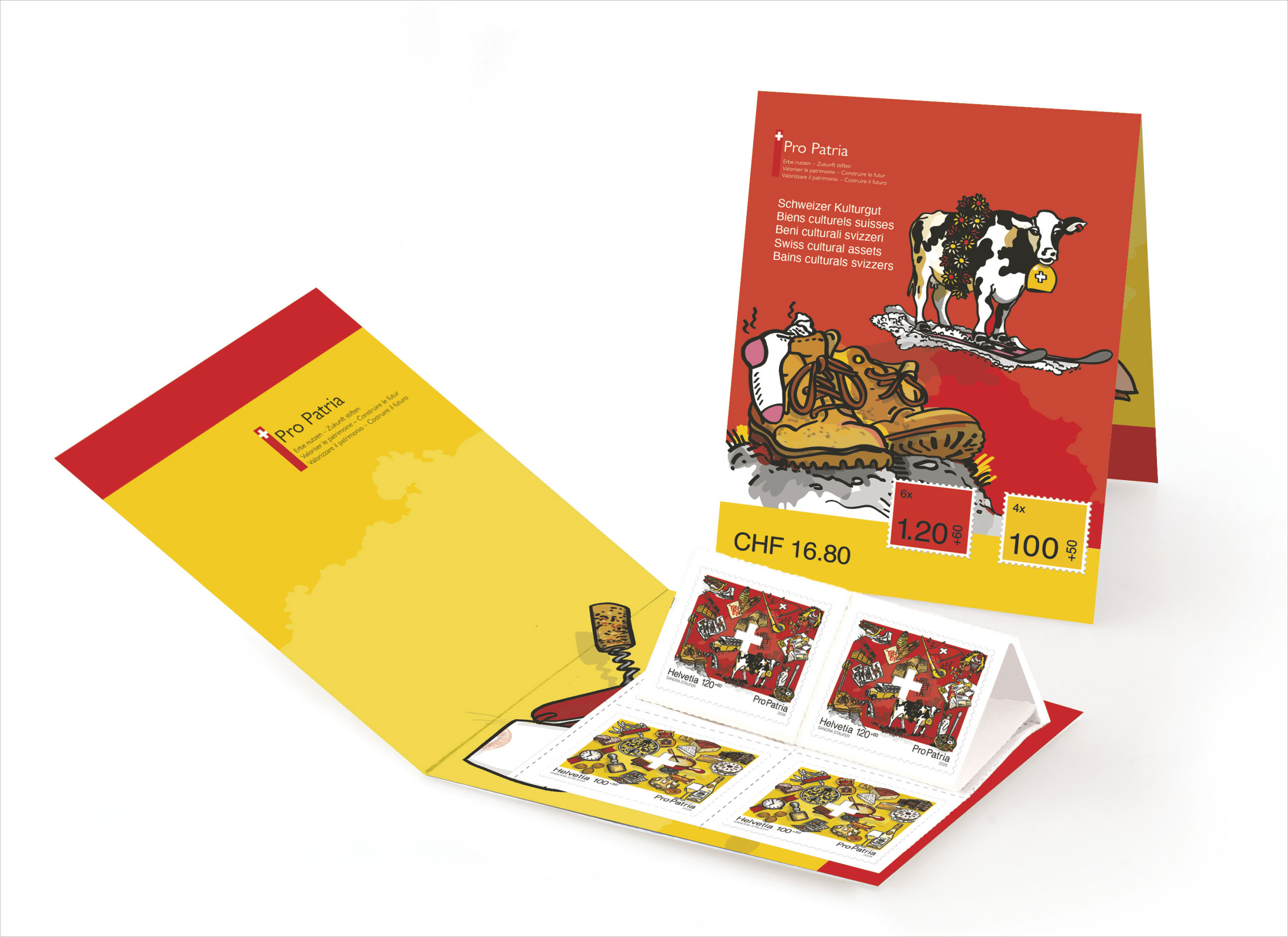
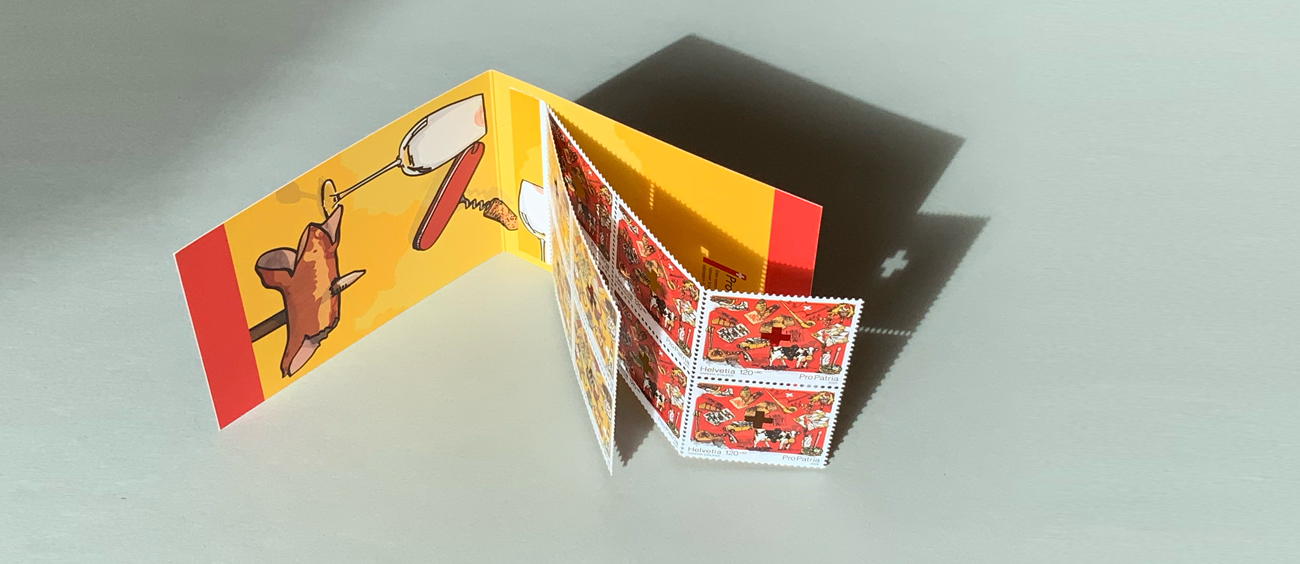
In den weiteren Produkten - dem Kleinbogen, der Vignette und dem Booklet - entfalten diese Zeichen schließlich ihr Eigenleben.
Aus der Briefmarke herausgeschnitten wird das Schweizer Kreuz zu einer leisen, zarten Erinnerung daran, wie die eigene nationale Identität verblassen kann, wenn das Leben sich fern der Heimat entfaltet.
"Jo, das händ Sie aber schön gmacht."
Postmaster Aargau, 7 May 2026
Interview - iyf.ch - English
On behalf of the Swiss Post for the magazine Lupe.
Pro Patria ‒ Swiss cultural heritage
Question 1. You live as a Swiss expat in Brighton. How has the geographical distance changed your perspective on Switzerland and its cultural heritage?
The distance that comes with living in Brighton has not diminished my connection to Switzerland; rather, it has sharpened my perspective on Swiss cultural heritage. Distance acts like a lens. When you live within a culture, you often take its values for granted. Abroad, you become aware that you shift from being a participant to being an ambassador. This deepens both the sense of pride and the responsibility to pass on these values.
While the Swiss Army knife, Leckerli, and Hergiswil glass are everyday elements of our life here in Brighton, what I miss most is Swiss design - that timeless precision and clarity embodied by typographers such as Miedinger, Müller-Brockmann, and Ruder. Their work represents special cultural assets to me; they decorate my studio and remind me of the connection between tradition and innovation.
Our family life is consciously interwoven with Swiss threads. Shared holidays and our son’s military service have created strong ties. With every visit to a Swiss cultural site, such as Ballenberg, the Museum of Applied Arts, or the Paper Museum, I feel a deep sense of belonging. These places evoke a warm nostalgia for values that have inevitably shaped our family.
One of my greatest challenges has always been bridging the geographical distance to Switzerland for our children. But by continually bringing them back to Switzerland and familiarizing them with these cultural places, they are now able to easily call Switzerland their home.
For decades, I was a proud cultural ambassador in Brighton. Now, through this stamp design, I have the honor of becoming part of that heritage myself.
Question 2. When you think of Swiss culture, what is the first thing that comes to mind? Is there a symbol, a feeling, or a moment that feels particularly Swiss to you?
When people look at this stamp, my greatest wish is that they feel an immediate sense of nostalgia and home. This design is rooted in those deeply embedded fragments of memory that define Switzerland for me. The two bold colours - the characteristic Swiss red of our flag and the much-loved yellow Post bus - are not just colours; they are inseparably linked to the warmth and sense of belonging from my childhood. They form the emotional foundation of the design.
Beyond this initial feeling, I hope the stamp encourages a rediscovery of the details of our cultural heritage. I drew inspiration from the precise patterns of traditional Swiss textile craftsmanship, the fine embroidery of St. Gallen, and the details of Appenzell shirts.
I wanted to create a design that works on two levels: from a distance, it appears as a decorative pattern that immediately conveys a familiar visual identity. Upon closer inspection, the stories of Swiss cultural heritage unfold in all their richness. It is a visual invitation to pause and appreciate the details of our traditions.
Question 3. What do you hope people feel or perhaps rediscover when they look at the stamps?
Cheese is, of course, an essential part of it for me. At Zurich Airport, the same small scene repeats itself every time: with my raclette cheese in my luggage, I walk through customs, and the officers, smiling, call out: “Swiss abroad?” - followed by an equally friendly “All good!” A moment that fills me with a warm sense of belonging every single time.

Question 4. How do you capture the full diversity of Switzerland on just a few square centimetres of paper? What was your design approach, or what was the biggest challenge?
When I began this project and reflected on the design as a Swiss living abroad, I wanted to capture the essence of what defines Swiss cultural heritage. Naturally, this led me to engage with all 26 cantons - each rich in its own characteristics, traditions, and distinctive identities. Only in their entirety does that diversity unfold, reflecting the beauty of Swiss cultural heritage so vividly.
As I experimented, it quickly became clear how small the design space of a stamp really is. But rather than seeing this as a limitation, I viewed it as a creative challenge - to find symbols that convey the essence of this nostalgia.
In the accompanying products—the miniature sheet, the vignette, and the booklet - these elements are finally able to take on a life of their own.
When cut out from the stamp, the Swiss cross becomes a quiet, delicate reminder of how one’s national identity can fade when life unfolds far from home.